
Our Services


Book your appointment now
Just click below to book your appointment with Alan.
Alan was instrumental in getting me back to full fitness after my ankle surgery in the 2017/18 season. He’s a top Physio and a good man.
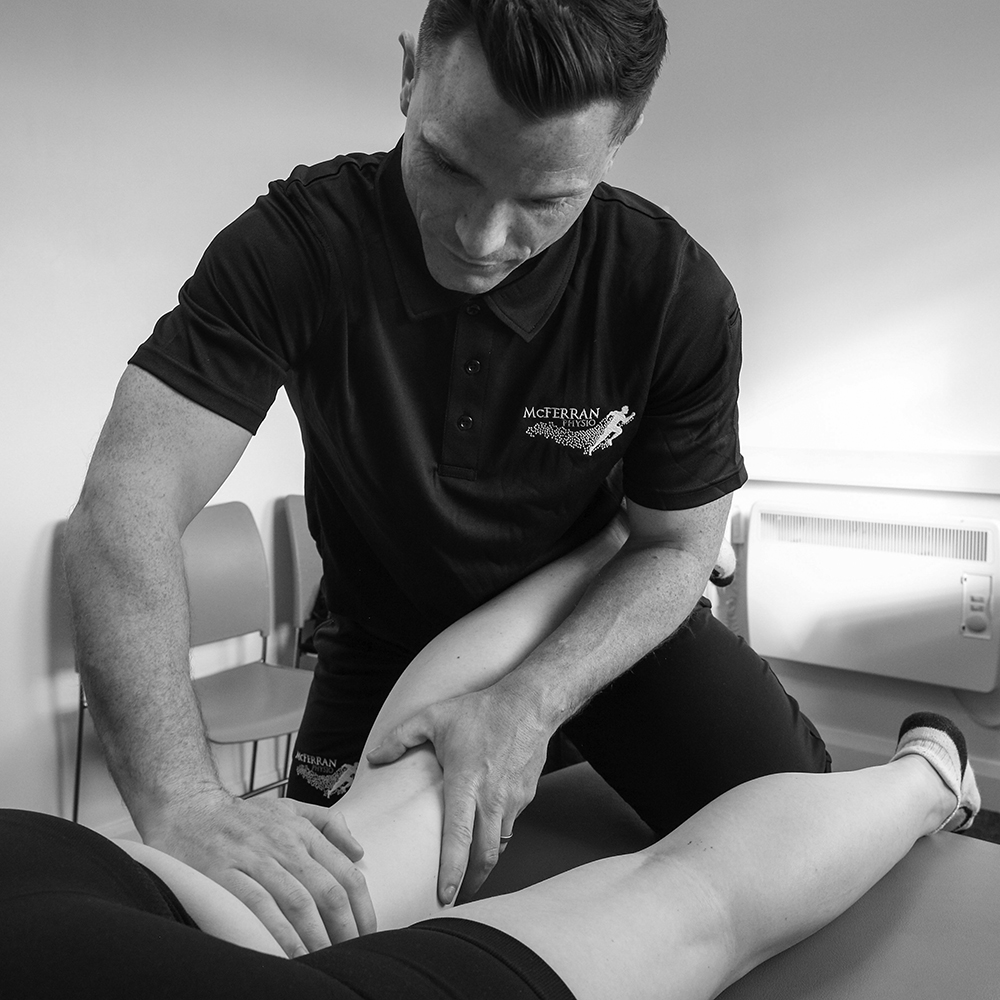
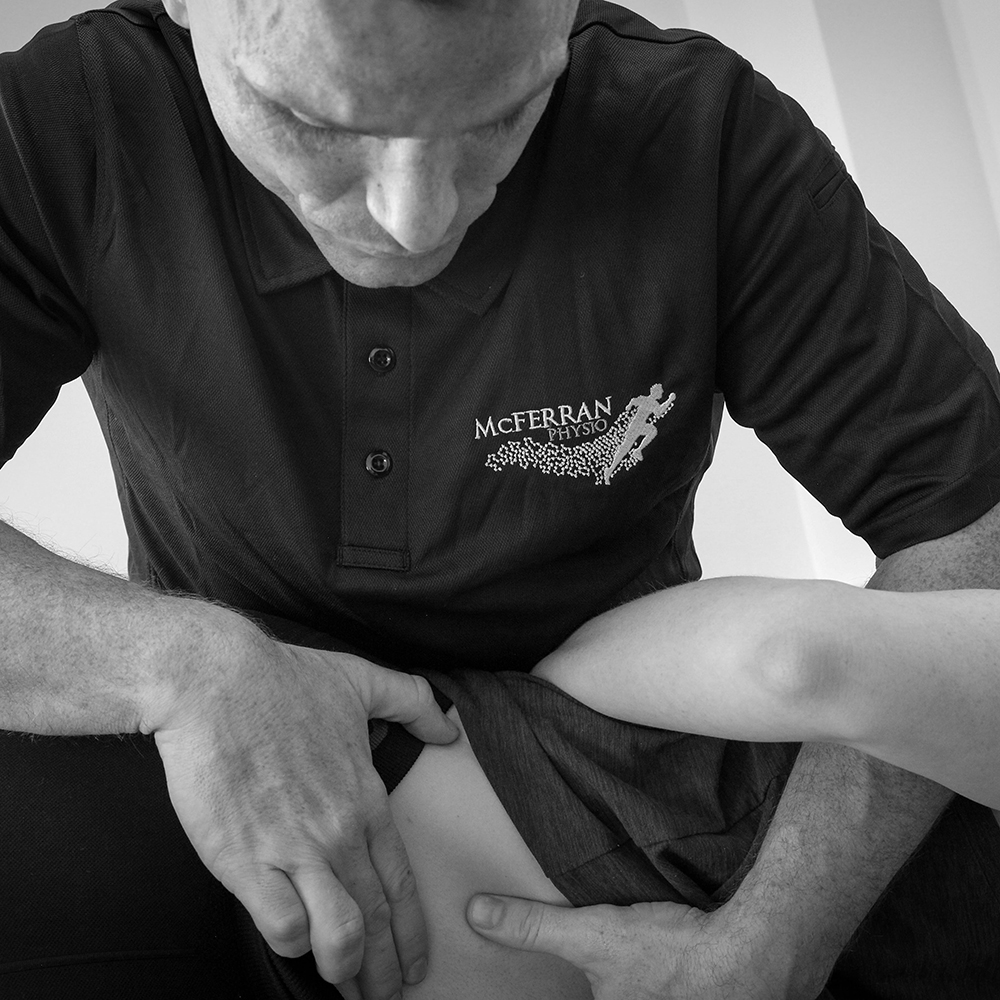
Soft Tissue Therapy is the management, manipulation and rehabilitation of soft tissues of the body, including muscles, tendons and ligaments. It is worthwhile not just for sports people, but for anyone wishing to guard against or recover from a soft tissue injury.
Soft Tissue Therapy may:
- Improve circulation and lymphatic flow.
- Sedate or stimulate nerve endings.
- Increase or decrease muscle tone.
- Increase or decrease muscle length.
- Remodel scar tissue when required.
- Help in preparing mentally for sports.
You don’t need to play sports to benefit from Soft Tissue Therapy. The benefits above can also help relieve many day-to-day problems we can all face – such as repetitive strain injury, sprains, tension and fatigue.
The treatment techniques used at McFerran Physio include:-
– Myofascial release
– Trigger point therapy
– Cupping massage
– Sports massage
Contact us about Soft Tissue Therapy
How does kinesiology tape work?
When applied correctly, it causes the skin to form convolutions and wrinkle. This decompresses the tissue immediately below the skin which can improve lymphatic and blood flow around the area, improves the glide and slide between tissue layers and alters the perception of pain and thus reduces symptoms.
Key benefits of using kinesiology tape:
– Assists to decrease pain
– Provides functional support whilst allowing full range of movement
– Hypoallergenic – no zinc oxide or latex
– Water resistant – can be worn for up to 5 days
What are the key symptoms kinesiology taping might assist?
– Muscle pain. E.g., low back pain or neck pain
– Joint pain. E.g., shoulder or knee pain
– Sports and non-sports injuries. E.g., shin splints, plantar fasciitis.
Contact us about Kinesiology Taping
Alan has been working with professional footballers and elite athletes for ten years and has extensive experience of treating semi-professional footballers, rugby players and amateur sports people.
ACUTE INJURY MANAGEMENT:
The key to management of any sports injuries is early, accurate diagnosis. Once diagnosed, an appropriate treatment plan can be administered and, if necessary, onward referral for further investigations (MRI, X-Rays) or the opinion of a consultant.
We have an extensive network of specialists to ensure your injury is managed by the best professionals available.
CHRONIC INJURY MANAGEMENT:
Very often sports injuries become chronic (long term) due to:
- Return to sport too early
- Misdiagnosis or poor management
- Ineffective treatment
- Poor rehabilitation
Commonly these injuries include:
- Recurrent muscle injuries e.g. hamstrings, calves or quads
- Tendinopathy such as Achilles tendinopathy, tennis elbow, plantar fasciitis and rotator cuff tendinopathy
- Groin pain
- Low back pain and neck pain
At McFerran Physio we will provide:
- Accurate diagnosis
- Hands-on treatment
- Functional movement screening
- Structured rehabilitation programme
- Effective onward referral if you are unlikely to respond to physiotherapy
Contact us about Sports Injuries
Acupuncture is a form of traditional Chinese medicine and has been used for thousands of years. It involves inserting fine needles to specific acupuncture points in the body.
Traditional Chinese acupuncturists believe there is an energy flow in our body which when stagnant becomes physical pain. Needling certain points can improve this flow of endorphins (natural painkillers), restoring balance to the body.
Alan been trained in acupuncture pain relief from a Western approach. Research has shown that as well as releasing endorphins, needling specific points can stimulate blood flow around the painful area.
Acupuncture can be used for any painful area and, in our experience, the most successful conditions treated include:
– Trapped nerves
– Acute whiplash
– Dead legs
– Tennis elbow
– Shin splints
Alan has been trained by, and is registered with, the Acupuncture Association of Chartered Physiotherapists. He performs the treatment using sterile needles and hygienic conditions.
Contact us about Acupuncture
After most surgery your surgeon will normally have a rehabilitation protocol they wish you to follow.
We communicate with the surgeon to gain information on the surgery and regime to follow.
Rehabilitation includes:
– Swelling control
– Restoration of maximum available range of movement
– Activation of weak muscles- Initially via muscle stimulator machine
– Restoration of full muscle flexibility and strength
– Gym rehabilitation
– Structured return to sport rehabilitation
– General cardiovascular fitness
What conditions are commonly seen?
– Knee Surgery – cruciate ligament reconstruction
– Arthroscopies
– Hip and knee replacements
– pinal surgery
– Ankle arthroscopies or ligament repairs
– Shoulder surgery i.e. stabilizations
Contact us about Rehabilitation
We specialise in preparing you for surgery and rehabilitation post-surgery.
PRE-SURGICAL TREATMENT:
The most important part of pre-operative treatment is keeping you informed. We will aim to answer all your questions, which may entail:
- What exactly does the surgery involve?
- How long should recovery take?
- How much pain, swelling and short-term disability will the surgery cause?
- What will the post-operative rehabilitation involve?
- When are you likely to return to work or sport?
It is vital before surgery to have as much knowledge of your condition and probable outcome as possible, so you can prepare mentally and physically for what lies ahead.
The physical preparation involves ensuring your whole body is ready, not just the areas awaiting surgery.
WE AIM TO
- Achieve maximum range of movement at the affected area.
- Activate muscles around the affected area.
- Maintain general cardiovascular fitness such as by cycling or swimming etc.
- Reduce swelling around the affected area.
The stronger, fitter and more mobile you can be before your op, the quicker you will tend to recover afterwards.
POST-SURGERY TREATMENT:
After most surgery, your surgeon will normally have rehabilitation ‘rules’ they want you to follow. We will discuss this with your surgeon to get the details we need about your operation and planned recovery schedule.
Rehabilitation includes:
– Swelling control.
– Restoring maximum possible range of movement.
– Activating weak muscles.
– Restoring full muscle flexibility and strength.
– Gym rehabilitation.
– Structured return to sports rehabilitation.
– General cardiovascular fitness.
What conditions do we commonly see?
– Knee surgery – cruciate ligament reconstruction.
– Arthroscopies (key-hole surgeries).
– Hip and knee replacements.
– Spinal surgery.
– Ankle arthroscopies or ligament repairs.
-Shoulder surgery such as stabilisations.
Contact us about Surgery Prehab & Rehab
At McFerran Physio, Exercise Prescription is one of our core treatment approaches.
We are experts in advising you when it is safe to exercise, and how much you can increase weight and load to your joints and muscles, ensuring a perfect technique while you do so.
Following a thorough movement analysis, Alan will use his expertise in anatomy, physiology and biomechanics to prescribe a specific and safe exercise programme that will take you from the early stages of your injury, to getting back to your favourite activities or sport.
At McFerran Physio, we aim to help you to manage your own progress through recovery, and also help you prevent future injuries. During your rehabilitation, Exercise Prescription is usually combined with hands-on manual therapy or other treatments, to ensure the best possible outcome.
When is Exercise Prescription commonly prescribed at McFerran Physio?
- Pre and post-surgery rehabilitation.
- Sports injury rehabilitation.
- Post-natal.
- Back and neck problems.
- Children’s motor development.
- General fitness and well-being.
The choice of exercises is designed to improve:
- Awareness and muscle activation.
- Mobility and stretching.
- Stability, core strengthening, Pilates.
- Control, strength training and endurance.
- Balance, proprioception and coordination.
- Functional movement and sport-specific conditioning.
- Cardiovascular fitness.
Contact us about Exercise Prescription
Back and neck pain is one of the most common health complaints, affecting eight out of ten people at some point during their lives. The lower back is the area most often affected. For many people, back pain goes away on its own after a few days. But for others, the pain can last for weeks or months, sometimes years. Lower-back pain can incapacitate you, and it is a difficult condition to diagnose, treat, and study.
At McFerran Physio, we are qualified in spinal mobilisation and manipulation. We use our hands to apply a controlled force to specific areas of the spine as required, varying the strength depending on the treatment required. Combining this treatment with an appropriate home exercise programme following an in-depth movement analysis, will provide a safe and effective way to reduce your lower-back pain and restore your mobility.